
You get to know VINORUM
by using it.
No video, no salesperson. Four steps show the principle — you type once and watch four times what came of it. After that the whole program is open to you.
- Real screens from the program
- Every unit reachable on its own
- All figures are sample data
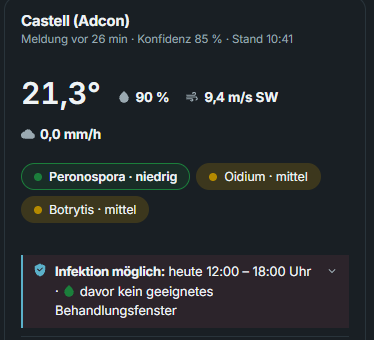
Here wine law is a result, not a form.
In classical programs you enter figures you gathered somewhere else first. In VINORUM the figure in the declaration comes from the same entry you made while working in the cellar.
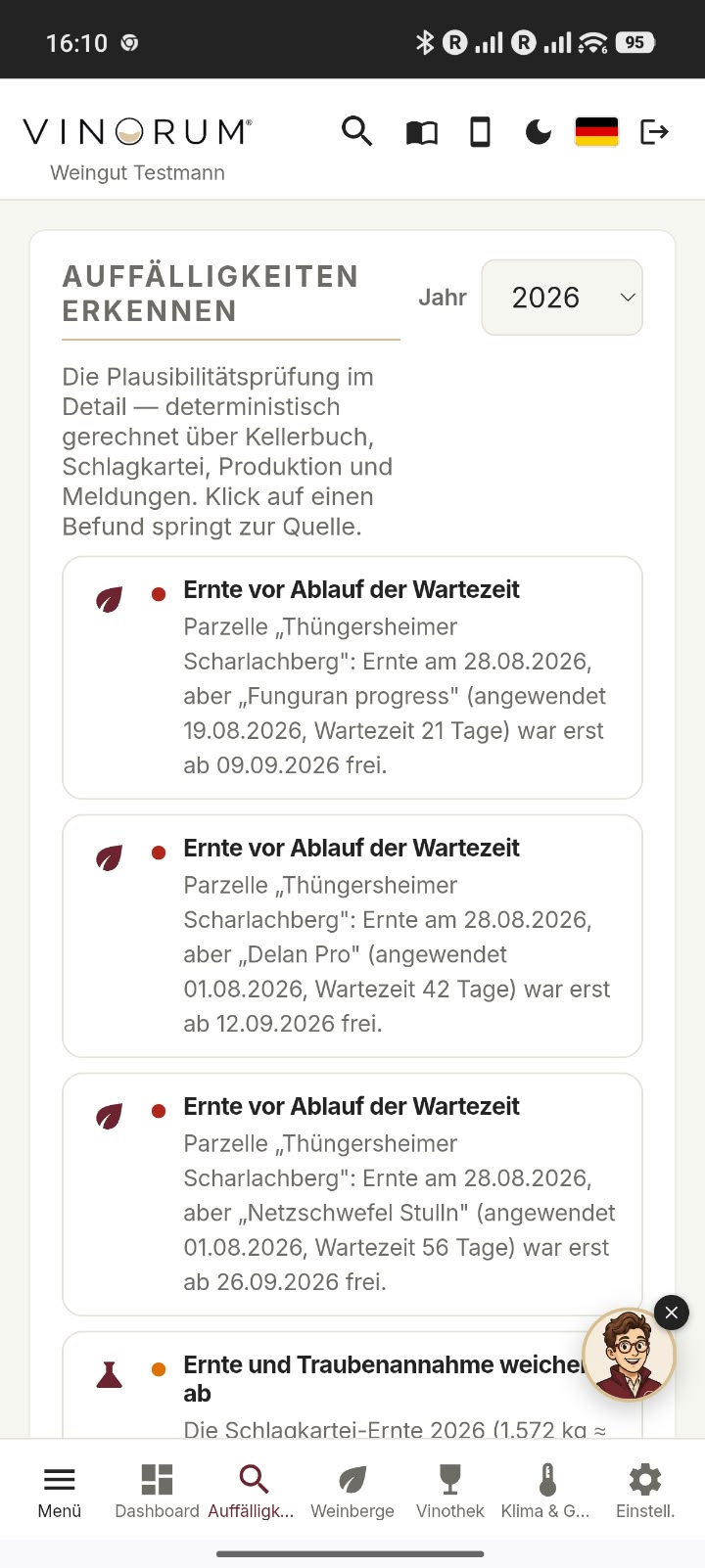
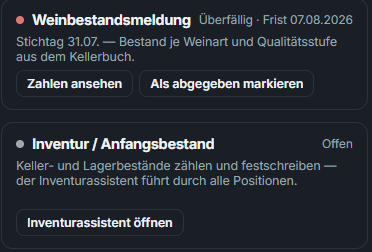
Plausibility before the inspection. Does the harvest quantity match the grape intake? Do bottling litres and bottle count agree? Are there negative stocks? VINORUM asks that before anyone else does.
And it asks again afterwards. If entries were made after submission, VINORUM says so: “the stock has changed since the declaration”. Nobody else makes that comparison.
The inspection folder is one PDF. Vessel register, stocks, accounts, records, journal. When the inspection comes, you print once.
Stocktaking with an assistant. Count list for cellar and warehouse, enter the actuals, see the differences — on committing they become proper entries with a protocol. Saving in between included, because a stocktake rarely happens in one sitting.
- no longer needed No gathering, no recalculating, no night before the filing deadline.
- appears on its own The inspection folder comes as a single PDF: vessel register, stocks, accounts, records, journal.
All 8 functions in this area
What is listed here is built and in use. What is not finished is deliberately not on the list — do ask about it.
Declarations as an extract of the books
The stock declaration, the harvest and production declarations and the fertiliser documentation come out of the cellar book and the field record — as a PDF, with a snapshot in the register.
The declaration is an extract of books you keep anyway. No second set of records.
Deadlines with lead time
Curated dates create tasks in good time — once per deadline, not afresh on every visit.
No deadline hangs on one person’s memory any more.
Spotting what stands out — fourteen plausibility checks
Among them: the difference between harvest and intake, a negative batch, a maximum yield exceeded, a harvest before the pre-harvest interval ended, a declaration that no longer matches today’s figures, sulphur values, several batches in one vessel, the nitrogen ceiling. The calculation is deterministic, across the cellar book, the field record, production and declarations, by vintage if you like. A click on a finding jumps to the place it came from.
The system finds what stands out before the inspector does.
Inspection folder as a single PDF
A checklist with a traffic light plus one package: vessel register, stocks, journal and certificates in one file.
When the wine inspection rings the bell, the folder is a printout.
Stocktaking assistant
A counting list across cellar and warehouse, saving in between allowed; differences become regular entries and the record falls out as a PDF.
A stocktake that is written down properly instead of on spreadsheet slips.
Wine fund levies from real origin
Area and sales levies as a preview; sales are apportioned by actual origin, and bought-in wine does not count.
The figures are derived, not estimated — and the derivation stands next to them.
Packaging quantities from bills of materials
Reportable quantities come from the bills of materials times the quantities sold, split between consumer and trade, shipping cartons from the consignments.
The packaging report is calculated instead of guessed. Nobody weighs bottles.
Till data for the tax office
The standardised export for a till inspection, a backup of the security device store and a finished data sheet for registering the till.
The requirements for electronic tills without any specialist literature.