
You get to know VINORUM
by using it.
No video, no salesperson. Four steps show the principle — you type once and watch four times what came of it. After that the whole program is open to you.
- Real screens from the program
- Every unit reachable on its own
- All figures are sample data
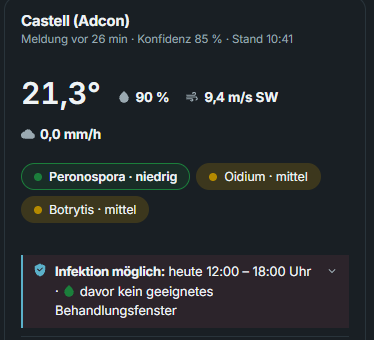
23:04. Somebody orders.
The usual arrangement: shop system here, merchandise management there, and between them an interface that runs overnight and sometimes sticks. In VINORUM that interface does not exist, because there is nothing to connect. Play the customer.
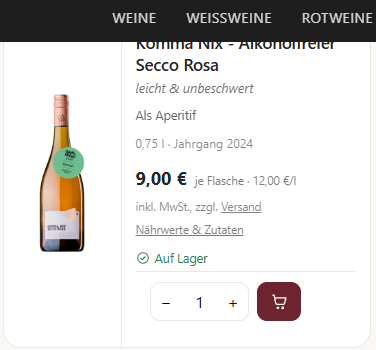
Enjoy your evening.
And afterwards: shop reports
Every shop system shows you top products. The more interesting list is the other one: which wine is not moving. Plus turnover by month, by category and by payment method — switchable to this month, last month, the year, or all time.
Sales channels
Show the same articles where customers are looking — without maintaining them a second time. Every channel states what it costs and where the sale is concluded: in your shop or on the platform.
A newsletter with a funnel
The recipients are your own addresses with the newsletter box ticked, and the unsubscribe link is attached automatically. After it goes out you see the whole path: who opened it, who clicked what — and which order came of it.
- no longer needed No duplicate article maintenance, no overselling.
- no longer needed No commission to a platform — the customer pays into your account.
- appears on its own An order at 11:04 pm is an order at 11:04 pm, with customer, prices and stock movement.
All 15 functions in this area
What is listed here is built and in use. What is not finished is deliberately not on the list — do ask about it.
Vinothek sales on a tablet
A touch grid with photos, customer group prices and one-off lines. New customers can enter themselves on the locked device.
A sale at the estate creates order, invoice and stock entry in one go — nothing to write up in the evening.
A till with a certified security device
A signature per receipt through a certified technical security device from the cloud, one till per device, a cash journal and a close-off with a counting record.
The till inspection becomes a printout — and the contract for the security device runs through VINORUM, not through you.
Card payment with a paired terminal
Card payment starts from the till on the paired terminal; the receipt number appears in the provider’s statement. Refunds run through a cancellation or a credit note.
Card payments without entering anything twice — and the statement agrees with the till.
Fallback mode when the network drops
The till switches to a number range of its own, keeps printing receipts and transfers later with the real time. The outage is documented.
The estate festival in a signal hole carries on — with a receipt for the guest and a clean record of the outage.
The shop is VINORUM
The storefront takes articles, wine data, stock, prices, awards and images straight from the business. Server-rendered, without tracking, with speaking addresses and structured data.
There is no second product database and no interface that jams overnight. Sold out means sold out.
Built for search engines and for AI answers
Every page arrives finished from the server, with speaking addresses and structured data per wine — so search engines and AI answer services read the text itself, not what a script loads later. Inside the shop, the wine advice draws on the same data.
Your wines are found and quoted correctly — including where people no longer click but ask.
Customer accounts and a trade view
The account belongs to the address, released group prices apply net, “your wines” is a quick reorder list. Which customer groups exist is up to you — a single merchant as readily as a whole group of them, each with its own prices and discounts. Restaurants get an ordering link that needs no sign-in.
The restaurateur reorders instead of ringing up — at their own prices.
Online payment into your account
Card, Apple Pay and PayPal in your own checkout. The order is provisional first and becomes binding when the money arrives.
The money is there before anyone packs — and VINORUM is never in the flow of funds.
Promotional prices with a stored price history
A struck-through price only appears where the lowest price of the last thirty days is on record; the price history cannot be altered.
Discount campaigns on a basis you can show.
Vouchers as a balance journal
Value and campaign vouchers at the till and in the shop, part redemption a matter of course. Redemption is a means of payment with the correct VAT; the PDF carries a motif and a QR code.
Vouchers are clean for tax and never get lost — the balance can be recalculated.
Wine advice in the shop, with guard rails
Advice from your own wine data. The server only shows wines that exist and are available, and it filters out health claims. Without AI a rule-based adviser stays in place.
Advice like at the counter, around the clock — with nothing that can be invented.
Newsletter with proof of consent
Mailings with placeholders, a consent record (when and from where) and a delivery log per recipient, with an unsubscribe link.
Advertising to people who asked for it — and you can prove it.
Audiences built from real behaviour
Select recipients by last purchase, variety bought, a visit as a guest, turnover or postcode. Whether a channel may be used is decided by the server, not by the user.
“Everyone who bought Silvaner and has ordered nothing for twelve months” is a selection, not a night with a spreadsheet — possible only because the shop, the till and the address book are the same system.
Product feeds for portals
One feed per channel out of the article file, with a mandatory-field check and a guard against health claims that are not allowed.
Being found on portals without maintaining product data twice.
The e-label behind the QR code
Ingredients and nutrition per wine on a separate, neutral address — no tracking, no advertising. For a pack, every wine it contains appears.
The QR code on the label leads to a page that shows exactly that and nothing else.