
You get to know VINORUM
by using it.
No video, no salesperson. Four steps show the principle — you type once and watch four times what came of it. After that the whole program is open to you.
- Real screens from the program
- Every unit reachable on its own
- All figures are sample data
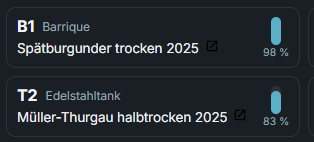
Every vessel knows what is inside it.
A cellar book that only works at the desk gets written up in the evening from memory. VINORUM books where the work happens — and carries the origin of every batch through all the moves.
Nothing is deleted. Corrections are counter-entries; the stock is always the sum of the journal and never a number somebody overwrote. The stock on any given date is one click away.
Blending is one operation. Several batches become a new one: VINORUM books the outgoings and the incoming together and passes on the origin proportionally. Without that, a blend counts as its own harvest and a bought-in share disappears from the record.
Analyses belong to the vessel, not the batch. If a wine sits in four vessels it develops four different ways — so the history shows one line per vessel, on a shared time axis.
- no longer needed No note in a pocket, no evening shift at the desk.
- no longer needed No separate stock list, no back-calculation to a reference date.
- appears on its own Origin per batch is carried through blending — which saves the guesswork in the wine fund declaration.
All 10 functions in this area
What is listed here is built and in use. What is not finished is deliberately not on the list — do ask about it.
A cellar book with an unbroken run of numbers
Stocks are always the sum of the entries, never a field to overwrite. Corrections happen solely by reversing entry.
Your wine records are audit-proof by construction. There is no “quick fix”.
Vessel register
Every tank and every barrel with its number, volume, location and what is currently in it.
The register an inspection asks for first is always up to date.
Blending with proportional origin
A blend posts the outgoing and incoming quantities in one transaction; the shares from your own harvest and from bought-in wine pass on proportionally — through every move.
Labelling law and levies work from real shares instead of estimates.
Analyses per vessel as a curve
Series of analyses per tank or batch, plotted over time.
You see the development instead of reconstructing it from slips of paper.
Sulphur guard before bottling
Free and total sulphur dioxide are checked against the applicable limits, with a warning before you fill.
The sulphur stays within range before the bottle is full, not afterwards.
Enrichment calculator
The amount of sugar per per cent of alcohol by the applicable figure, with a warning at the zone boundary; the result goes straight into the entry.
Calculating and documenting are one step, not two.
Bottling posts everything in one run
One run creates the cellar book outgoing entry, the finished goods incoming entry and the material consumption from the bill of materials per packaging — including a query about losses.
2,000 litres become 2,660 bottles, with every entry made and the lot on the label.
Batches and lots per bottling
Every bottling creates a lot with period, official test number, vessel and number of bottles; sales are counted against the lot.
In a recall, “which bottles?” is a piece of information, not a night shift.
“In the cellar” — scan and post without wifi
Vessel labels with a QR code, scanning at the tank, entry without a connection. The queue transfers later and prevents double entries.
You post at the barrel instead of leaving a note on the cellar stairs.
Trace a bottle back into the vineyard
From article and lot backwards: bottling, cellar book, grape intake, field record, parcel — as a PDF.
Traceability is one button — and it is honest about where it breaks.