
You get to know VINORUM
by using it.
No video, no salesperson. Four steps show the principle — you type once and watch four times what came of it. After that the whole program is open to you.
- Real screens from the program
- Every unit reachable on its own
- All figures are sample data
You pick the product. VINORUM knows the rest.
The record-keeping duties grew in 2026: authorisation number, rate, BBCH stage, leaf wall area. With VINORUM you do not copy any of that out. Pick a product on the phone and watch.
The authorisation number, the pre-harvest interval and the rates come from the official catalogue. The requirement calculator tells you how much you need for your area, product and water. You leaf through no package insert. In a tank mix this works with as many products per pass as you like, each with its own interval.
The guard · six weeks later
The application was booked on 28 August. Now the harvest is due. When does the trailer roll?
Choose a product first.
Climate & vine health · your own weather station
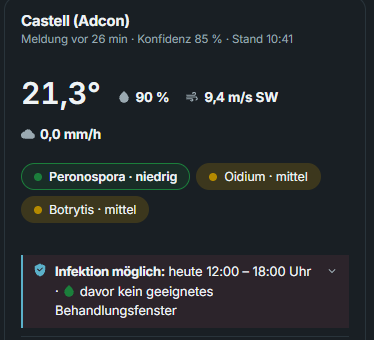
Three models run on the readings from your own station, not on a regional average. Plus a seven-day outlook. And the question that counts: when does the weather suit spraying?
- no longer needed No spreadsheet, no looking up pre-harvest intervals, no tally sheet for active-substance groups.
- appears on its own The plant protection report appears alongside — row spacing and canopy height belong to the parcel.
- appears on its own The fertiliser record per parcel comes out of the field records, with annual total and N load.
All 24 functions in this area
What is listed here is built and in use. What is not finished is deliberately not on the list — do ask about it.
Parcels on the aerial image, drawn or imported
Draw the areas on the aerial image or take over official exports; the area is calculated from the polygon.
The areas for your applications are in within minutes, and nobody types a hectare figure by hand.
Official parcel identifiers per federal state
The land parcel identifier comes from the relevant state service at the click of a button.
Nothing is copied out of an application form, so no digits get transposed.
Field record with mandatory-field logic
Every operation — plant protection, fertilising, soil, canopy, harvest — with exactly the details required. Entries cannot be altered, and every deletion is logged.
The documentation comes into being as you work and is complete when an inspector arrives.
Official product catalogue, refreshed weekly
Every plant protection product for viticulture with its authorisation number, rates per growth stage, pre-harvest interval, conditions and active substances — straight from the authority interface.
The product list knows more than the folder of data sheets, and it is never out of date.
Seven guards when you save
As a spray is saved, VINORUM checks: has the authorisation expired? the buffer zone? the number of applications? the bee condition? the same substance group too often? is the operator still qualified? has the machine been tested?
Mistakes become visible at the moment of the decision — as a warning, never as a block.
Plant protection report in the official column set
The report appears in the form that becomes mandatory in electronic shape from 2027 — with leaf wall area, rate per unit of area and EPPO code.
The new record-keeping form is a printout, not a project.
Pre-harvest interval guard, right up to the harvest
Every spray sets a date from which harvesting is free again. Harvest entry and harvest cockpit warn before anyone goes in too early.
No harvest inside a running pre-harvest interval — the most expensive mistake of the autumn simply cannot happen.
Growth stages with a year-on-year comparison
Forty-three stages to choose from, observations as a curve — alongside them the previous years and their average as separate timelines. Observations can be added at any time; forecast stages are kept apart from observed ones.
“Are we early this year?” becomes a number: ten days earlier than the average of the two previous years, measured at the onset of ripening.
Ripeness forecast that recalibrates itself
A heat-sum model calculates the dates of the stages from the weather series; every observation you enter calibrates it further. Every model stage and every vintage is there as a table alongside.
Harvest and work planning with dates instead of rules of thumb.
AI diagnostics — in development
A diagnostic aid for the vineyard, currently being built. Available from the 2027 growing season.
It stands here because it is coming — not because it already works.
Report damage with position, photo and no signal
A broken post, game damage, theft — with position, photos, an optional task, a map marker, a materials list and an insurance PDF.
The damage you spot on the pre-harvest round is recorded before it is forgotten.
“In the vineyard” — the phone knows the parcel
Position in, parcel out: risk, pre-harvest intervals and the last operation are there at once.
You document where the work happens, not in the evening from memory.
Lease deadlines that speak up
Lessor, term and notice period belong to the parcel; a task appears in good time before the cut-off date.
No lease renews itself unnoticed.
What you need to order before the season
Last year’s consumption per product is set against your stock AND against the authorisation status of today.
You order what is still authorised, not what stood on the shelf last year.
Weather per site: own station, network or model
Three kinds of source side by side; under every value it says where it comes from.
Weather for your site rather than “somewhere in the village” — and without a station of your own you can still start.
Three disease risk models, with their reasoning
Downy mildew, powdery mildew and botrytis per station as an indicator — with the rule behind it and the protective effect of the sprays you recorded.
A look in the morning tells you where the risk is rising and why. A decision aid, not a spraying recommendation.
Seven-day risk outlook with infection windows
The official forecast runs through the same models; upcoming infection windows are stated as a plain period.
You treat before the window, not after it.
Spraying conditions hour by hour
Wind, gusts, rainfastness and evaporation give an hourly indicator, tied to the infection windows.
“Tonight, 7 to 11” instead of a hunch — deliberately the conditions only, never the product.
Rain radar with a two-hour outlook
The official radar as a film, plus a line at the estate: “expected from about 08:05”.
The question “can we still get this load in?” is answered by a glance.
Severe weather warnings matched to your areas
Official warnings are checked against the estate address AND against every parcel polygon.
The warning applies to your sites, not to the district.
Hourly day forecast at every station
Temperature, wind and humidity as a daily curve, with rain bars and night zones.
The comfort of a weather app, where the work already happens.
Harvest cockpit
Per parcel: ripeness, whether harvesting is free, seven days of weather, the last quantity brought in. Above it, free tank space and the people available.
“Can we bring in the Silvaner on Saturday?” is one view instead of four phone calls.
Loads recorded at the weighbridge
Gross minus tare — you scan the trailer by QR code — plus must weight, condition and how it was brought in. One save posts the field record AND the cellar book in a single transaction.
One weighing, two statutory books. The origin of the batch is settled in the same moment.
Harvest overview with a yield indicator
Brought in today and in total, weighted must weight, kilograms and hectolitres per hectare against the maximum yield of the region.
The state of the autumn is live — and the harvest declaration in January works from the same figures.